
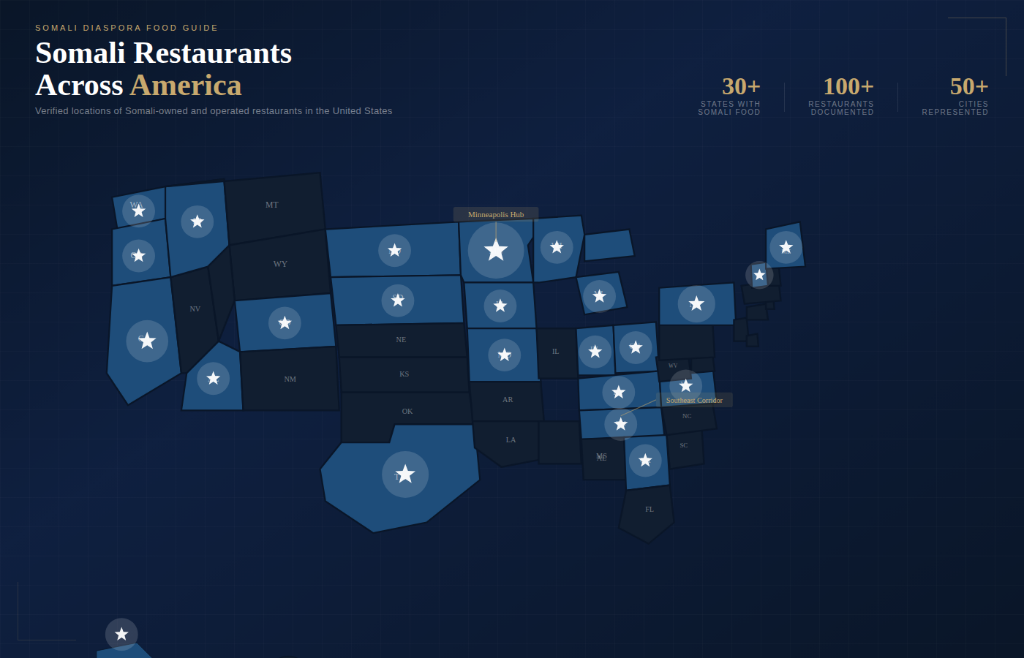
Somali Restaurants Across America: 30+ states, 100+ restaurants, 50+ cities documented by Rizqly.
Where to Find Somali Restaurants in the United States
Somali food in America is more widespread than most people realize. The Somali diaspora has built a remarkable food culture across the country. While Minneapolis and Columbus, Ohio are the best-known hubs, Rizqly has documented Somali restaurants in over 30 states and 50+ cities.
Minneapolis, Minnesota is the undisputed capital of Somali food in America. The Cedar-Riverside neighborhood, known locally as "Little Mogadishu," has the highest concentration of Somali restaurants in the country.
Columbus, Ohio has the second-largest Somali population in the U.S. and a thriving restaurant scene centered on the North Side neighborhoods.
Seattle, Washington has an established East African community in the Rainier Valley neighborhood, where Somali restaurants sit alongside Ethiopian and Eritrean spots on Rainier Avenue South.
San Diego, California has a significant Somali community in the City Heights neighborhood — one of the most diverse restaurant strips in Southern California.
Nashville, Tennessee has one of the fastest-growing Somali communities in the South, and its restaurant scene reflects that growth with multiple highly-rated spots.
Somali Restaurants in Unexpected Cities
One of the most remarkable things about the Somali diaspora food map is how far it extends beyond the major cities.
Fargo, North Dakota has four documented Somali restaurants including Hooyo's Kitchen, Rugsan Cuisine, and Al Hamdi Restaurant — a testament to the large refugee community resettled there since the 1990s.
Burlington, Vermont is home to Kismayo Kitchen, rated an exceptional 4.9 stars with over 700 reviews. Reviewers have driven from Montreal just to eat here.
Anchorage, Alaska has Safari Restaurant Somali Cuisine — a 4.7-star community gathering spot with a small grocery in the back. Finding excellent Somali food at the edge of the continent is one of the most surprising finds on the entire map.
Sioux Falls, South Dakota has a Somali restaurant that reviewers describe as the only halal spot in the city — a hidden gem.
Lewiston, Maine is a small mill city that has become home to a significant Somali community, with restaurants that serve as community anchors for the diaspora.
St. Cloud, Minnesota has one of the highest concentrations of Somali residents per capita in Minnesota outside the Twin Cities.
What to Order at a Somali Restaurant
If you have never eaten Somali food, the menu can feel unfamiliar. Here is what to order.
Bariis Isku-Karis is the cornerstone — fragrant basmati rice cooked with cumin, cardamom, cinnamon, and cloves, served with slow-braised meat (goat, lamb, or chicken). More subtly spiced than biryani, with its own distinctive flavor profile.
Suuqaar is quick-fried beef or goat cut into small cubes and cooked with onions, peppers, and Somali spice blends. Served with rice or canjeero, it is one of the most-ordered dishes at Somali restaurants in America.
Hilib Ari (braised goat) is the premium dish — slow-cooked bone-in goat in spiced broth, served over rice. Deeply tender and intensely flavorful. This is the dish to order if you eat meat and want the full Somali dining experience.
Sambusa are crispy fried pastry triangles filled with spiced beef or lentils, served as appetizers. Amina's African Sambusas in Boise, Idaho has built an entire restaurant around this single dish.
Canjeero is a spongy fermented flatbread used as both plate and utensil in traditional Somali dining.
Shaah is Somali spiced tea — black tea brewed with cardamom, cinnamon, and cloves, usually sweetened and served with camel milk. It is the centerpiece of Somali hospitality and the authentic way to end a Somali meal.
Standout Somali Restaurants Worth Traveling For
Rizqly has documented over 100 Somali restaurants across the United States. These consistently receive exceptional reviews:
Baobab Fare (Detroit, Michigan) — 4.8 stars with over 1,500 reviews. One of the most acclaimed East African restaurants in the Midwest, nationally recognized and featured in major food media.
Blue Star Cafe (Milwaukee, Wisconsin) — 4.8 stars with over 900 reviews. A beloved Milwaukee institution known for generous portions and exceptional quality.
Kismayo Kitchen (Burlington, Vermont) — 4.9 stars with 743 reviews, open Wednesday–Sunday only. The highest-rated Somali restaurant in Rizqly's database.
Kulan Cafe (Falls Church, Virginia) — 4.8 stars and beloved by the DC metro Somali community as a no-frills neighborhood gem.
Safari Restaurant Somali Cuisine (Anchorage, Alaska) — 4.7 stars. The fact that a beloved Somali restaurant exists in Anchorage is remarkable; that it is excellent makes it a genuine destination.
Tips for Your First Visit to a Somali Restaurant
Somali restaurants are almost universally family-owned, halal, and informal. A few tips will help you have the best possible experience:
Call ahead. Many Somali restaurants adjust hours seasonally, close for Friday Jumu'ah prayer, or run out of specific dishes. Calling ahead is always a good idea — and most restaurants appreciate it.
Go hungry. Portions are generous. This is food designed to satisfy after a long day, and Somali hospitality culture shows in how much arrives at the table.
Order the tea. Shaah is not an afterthought — it is the culmination of a Somali meal. Always have a cup.
Ask what's fresh. Daily specials reflect what the kitchen received that morning. If hilib ari is on the special, order it.
Bring cash. Many smaller Somali restaurants prefer or require cash. Confirm when you call ahead.
Frequently Asked Questions
Where can I find Somali restaurants near me?
Use Rizqly to search for halal restaurants in your city. Somali restaurants are documented across 30+ states and 50+ cities — from major hubs like Minneapolis and Columbus to unexpected cities like Fargo, Burlington, and Anchorage.
What is Somali food like?
Somali cuisine features fragrant spiced rice (bariis isku-karis), braised goat and beef, crispy sambusas, suuqaar (spiced fried meat), canjeero (fermented flatbread), and shaah (cardamom spiced tea). It is aromatic, deeply savory, and always halal.
Is Somali food always halal?
Yes. Somali cuisine is inherently halal — it contains no pork or alcohol. Somali restaurants in America use halal-certified or community-verified halal meat.
What should I order at a Somali restaurant for the first time?
Order bariis isku-karis (spiced rice with goat or lamb), sambusas as an appetizer, and shaah (spiced tea) to finish. If hilib ari (braised goat) is available, it is the signature dish of Somali cuisine.
Are Somali restaurants open during Ramadan?
Yes, but hours may shift. Many Somali restaurants extend their evening hours during Ramadan to accommodate iftar. Call ahead to confirm.
What cities have the most Somali restaurants?
Minneapolis (MN), Columbus (OH), Seattle (WA), San Diego (CA), and Nashville (TN) have the highest concentrations. Standout unexpected cities include Fargo (ND), Burlington (VT), Anchorage (AK), and Lewiston (ME).
Find businesses on Rizqly
More Muslim guides
Related Guides


Discover More on Rizqly
The largest directory of Muslim-owned and Muslim-serving businesses in America.